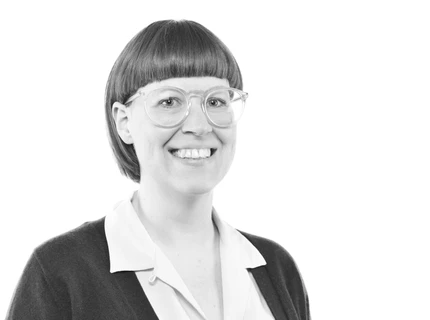
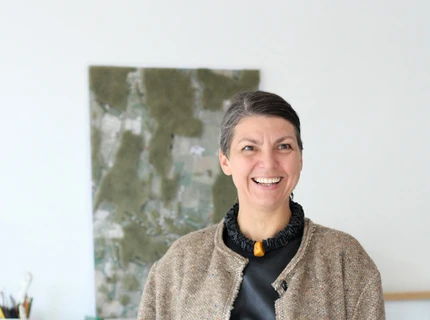
Kolding School of Design and SOSU Syd have joined forces to introduce design thinking and design facilitation into the education of future social and healthcare assistants. Pictured here is Line Gad Christiansen from Kolding School of Design, who leads the teaching alongside Kerstin Bro Egelund. The aim is to encourage more exploratory, creative and practice-based learning.
Design thinking enters the classroom at Denmark’s social and healthcare colleges
Less teacher-led instruction and more opportunities to explore, experiment and develop new solutions. These are some of the changes beginning to emerge in classrooms as teachers bring design methods from Kolding School of Design into their own teaching practice.
The collaboration was initiated by the Social and Healthcare College South (SOSU Syd), which, together with SOSU Øst, SOSU Fyn and ZBC, wanted to strengthen teachers’ skills in design thinking and facilitation. SOSU Syd therefore approached Kolding School of Design’s Continuing Education department.
The initiative was partly inspired by the positive experiences of a former member of staff who had completed a Diploma in Strategic Design and Leadership at Kolding School of Design and subsequently introduced new methods into the college’s development work.
At the same time, SOSU Syd wanted to strengthen the innovative approach of its DigiTech programme – a specialised pathway within the social and healthcare assistant qualification, focusing on digitalisation, welfare technology and innovation.
- We want to educate students who see opportunities rather than limitations and who have the confidence to think differently. But if we want to develop those skills in our students, we also need to equip our teachers to work in new ways, says Maili Isabel Jørgensen, Head of Education at SOSU Syd.

Maili Isabel Jørgensen, Head of Education at SOSU Syd, is already seeing signs that the new methods are increasing students’ engagement and active participation in learning.
Design methods as teaching tools
The result is two tailored diploma-level elective modules, Design Thinking as a Teaching Approach and Design Facilitation as a Teaching Approach. A total of 22 DigiTech teachers from SOSU Syd, SOSU Øst, SOSU Fyn and ZBC are currently taking part, exploring how design methods can be integrated into their teaching.
Led by Line Gad Christiansen and Kerstin Bro Egelund from Kolding School of Design, participants work with practical design methods such as ideation, personas and prototyping. These methods offer new ways of structuring learning activities in which students investigate real-world challenges, develop an understanding of people's needs and create and test potential solutions.
At Kolding School of Design, experimental, problem-based and workshop-led teaching is a fundamental part of the learning culture. The outcome is not necessarily defined in advance. By working with materials, prototypes and open-ended challenges, students learn to explore possibilities, formulate questions and develop their own solutions.
- In a design process, the outcome is not necessarily known from the outset. Students need to help explore the problem, ask questions and find their own direction. This requires teachers to let go of some control and instead facilitate a process in which students take greater responsibility and have the freedom to experiment, explains Kerstin Bro Egelund.
For SOSU Syd, it was important that the programme reflected the colleges’ specific needs. The two modules were therefore developed in close dialogue between the institutions, with particular emphasis on facilitation and the skills DigiTech aims to develop in its students: creativity, critical thinking, collaboration and problem-solving.

Kerstin Bro Egelund from Kolding School of Design teaches design thinking and facilitation, focusing on how teachers can create space for curiosity, experimentation and independent problem-solving.
Teachers experience what it means to let go
The experimental approach does not only challenge students. It also challenges the teachers, who are encouraged to work with open-ended processes in which neither the route nor the outcome is necessarily determined in advance.
According to Maili Isabel Jørgensen, this has been unfamiliar territory for some participants, particularly those accustomed to teaching within clearly defined structures. Although the approach has taken them outside their comfort zones, they have responded positively to the opportunity to explore new methods and perspectives.
- For some, working with more open-ended processes and less rigid structures has been challenging. But that is precisely the kind of situation we want our students to be comfortable with. That is why it is so important for teachers to experience this way of working themselves, she explains.
In other words, the teachers are not simply learning about design methods. They are experiencing first-hand what it means to work experimentally, explore the unknown and take greater responsibility for the learning process.
New methods are already making a difference
Although the professional development programme is still under way, SOSU Syd is already seeing how teachers are putting their new skills into practice.
- What they learn at Kolding School of Design is very quickly translated into their own teaching. They are already experimenting with the methods, and we can see that students are becoming more involved. Teaching is becoming more exploratory and practice-oriented, with students taking a more active role in shaping their own learning and having greater opportunities to contribute their ideas, creativity and professional knowledge, says Maili Isabel Jørgensen.
For her, this immediate practical relevance is one of the partnership’s greatest strengths. Teachers return with tangible tools they can put to use straight away, and early experiences suggest that the methods are changing how students participate in learning.
Kerstin Bro Egelund recognises this development from her work with other educational institutions.
- We are seeing growing demand from educational institutions for methods that make teaching more active and engaging. They want to spark students’ curiosity and motivation and encourage them to take greater responsibility for their own learning. This is where design thinking and our workshop-based approach can make a real difference.

Ideation, personas and prototyping provide social and healthcare teachers with practical tools to explore real-world challenges and enable students to develop and test their own ideas.
From the classroom to the future of healthcare
The ambitions extend well beyond the classroom.
DigiTech was developed by SOSU Syd in collaboration with the municipalities of Aabenraa, Haderslev, Sønderborg and Tønder to prepare social and healthcare assistants for a sector shaped by technological developments and changing needs.
In this environment, the ability to think critically, collaborate and develop new solutions is increasingly important. Design methods are intended to help students build these capabilities during their education.
Maili Isabel Jørgensen hopes that students will eventually carry this exploratory and innovative mindset into their practical training and later professional lives. It is too early to assess the longer-term impact, but the initial classroom experiences are encouraging.
In the longer term, the ambition is also for the new teaching methods to inspire other parts of the social and healthcare colleges. DigiTech serves as a space for experimentation, where new approaches can be tested before successful practices are potentially adopted more widely.
For Kolding School of Design, the collaboration demonstrates how design knowledge and methods can create value far beyond traditional design disciplines.
Bringing design into other professional contexts is not necessarily about educating more designers. It is about equipping more people with the tools to think differently, explore possibilities and drive change.
Through its collaboration with SOSU Syd, Kolding School of Design is helping to bring this approach into the education of future healthcare professionals – and into the development of new ways of teaching and learning.

The ambition is not only to transform teaching practices but also to strengthen future social and healthcare assistants’ ability to think differently and develop solutions in an ever-changing healthcare sector.