The Reading for Pleasure and Reading Spaces project brought together play, social interaction and child-centred design to develop new reading experiences rooted in children's own needs and everyday lives.
Perhaps children don't lack the desire to read – just someone to read with
Reading performance among Danish pupils is under pressure. The latest PISA results have once again sparked debate about children's reading habits. But if we want to encourage children to read for pleasure, focusing on books, reading practice and the number of minutes spent reading may not be enough. We also need to understand the place reading occupies in their everyday lives.
This was a central starting point for Reading for Pleasure and Reading Spaces (2021–2023), a project in which Kolding School of Design worked alongside researchers, teachers, librarians and children to explore how design could create new environments and opportunities for reading.
- One of our most important findings was that it wasn't reading itself that children were reluctant to engage in. It was that reading took time away from their friends and social lives.
As a result, it ended up at the bottom of their list of priorities, explains Karen Feder, Associate Professor and PhD at Kolding School of Design's Lab for Play Design.
Reading for pleasure is also about relationships
This finding suggests that encouraging children to read for pleasure is not simply about the individual reader. It is also about the social relationships and physical environments that shape the reading experience.
This calls for new ways of thinking about reading, as well as collaboration between the different professions involved in children's learning, wellbeing and everyday lives.
What if reading no longer had to compete with spending time together, but could instead become part of it?

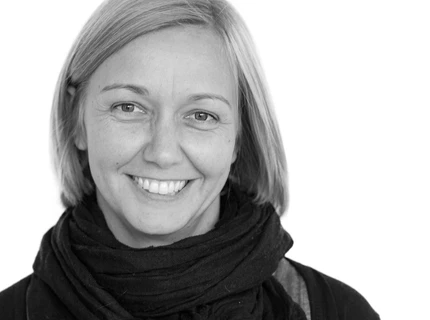
Karen Feder, Associate Professor with a PhD at Kolding School of Design's Lab for Play Design, highlights a key finding from the project: children did not necessarily lack the desire to read, but reading often took a back seat because it meant spending less time with friends and socialising. Photo: Maricel Cabiling
New reading experiences
This question became the starting point for the project's design experiments. Using a child-centred design approach, children were actively involved in developing new solutions. Their experiences and everyday lives informed experiments with reading spaces and activities.
- Using a child-centred design approach, our students developed a range of solutions that made reading a more social experience. And the children responded really positively, says Karen Feder.
One outcome was HUG ME, developed by design students Nina Sofia Gjødsbøl Ruder and Maia Louise Ronan. The large, soft installation invited children to settle down together, relax and immerse themselves in books.
Another example was the board game Gak Gak Go!, developed by students Esben Fjord Ørskov and Anton Bugge Nørgaard Olsen, which encouraged children to work together to invent characters and create stories.
Both solutions shared the ambition of making reading and storytelling activities that could also bring children together.
Children are experts in their own lives
The project also highlights the importance of involving children in the development of solutions intended for them. After all, although adults were once children themselves, they do not necessarily know what it means to be a child today.
By bringing together children's perspectives and the expertise of designers, researchers, librarians and reading specialists, the project was able to explore reading motivation from different angles and develop solutions that took account of both physical environments and children's social relationships.
Rather than simply asking children what they wanted, the project invited them to explore possibilities, develop ideas and test practical solutions alongside professionals.

The large, soft HUG ME installation invites children to read, relax and spend time together in a cosy, welcoming environment. Photo: Katrine Worsøe

The board game Gak Gak Go! turns storytelling into a shared experience, with children working together to invent characters and create stories. Photo: Katrine Worsøe
From design experiments to tangible insights
A total of ten prototypes were developed and tested in schools and libraries across Kolding Municipality. The evaluations showed that each solution had the potential to inspire reading for pleasure in different ways: by creating opportunities for calm and concentration, making books more accessible, and enabling children to share reading experiences and stories with one another.
For example, the evaluation of Gak Gak Go! found that 47 out of 52 children had created a good story with their friends and said they would, or might, like to play the game again. For HUG ME, 41 out of 53 children reported that the installation helped them settle down to read and that they would, or might, like to use it again.
The findings do not demonstrate that the children became more proficient readers. They do, however, show how design can help create environments that make reading more appealing and meaningful to children.
The project also illustrates the value of bringing together knowledge from different disciplines and involving the people directly affected by a challenge. When children's own experiences are given a meaningful role in the design process, new possibilities can emerge that might otherwise be overlooked from an adult perspective alone.
This is an insight that extends well beyond reading for pleasure – demonstrating how design can help us rethink complex societal challenges.
Explore the inspiration catalogue (available in Danish).

The Reading for Pleasure and Reading Spaces project resulted in ten different prototypes, which were tested in schools and libraries across Kolding Municipality. All shared the ambition of encouraging children to read for pleasure through play, opportunities for quiet concentration and new ways of enjoying books and stories together. Photo: Katrine Worsøe
About the project
Reading for Pleasure and Reading Spaces (Læselyst og læserum, 2021–2023) was carried out in collaboration with Kolding School of Design, the University of Southern Denmark, Kolding Libraries, Kolding's Educational Resource Centre and several schools in Kolding Municipality, among others. The project was supported by the Danish Agency for Culture and Palaces.