"At Kolding School of Design, we are interested in exploring alternatives to the status quo. We introduce an alternative in order to investigate how it is, for example, expressed, interpreted, generates dialogue, opens up other pathways, and potentially creates new practices and relations. Artefacts can be a way of examining this and of challenging both practice and theoretical positions and understandings," says Sune Gudiksen, Head of the PhD School at Kolding School of Design.
When research takes shape: Artefact-based PhD projects
“An artefact-based PhD project has to meet the same academic standards as any other PhD. The difference lies in how the research is developed, produced and analysed.”
At Kolding School of Design and Aarhus School of Architecture, PhD projects can take many forms. Besides the more familiar forms of PhD dissertations, such as the monograph and the article-based dissertation, some PhD students work with an artefact-based dissertation format, in which physical or spatial works, prototypes, models, films, installations, or other materialised expressions form a central part of the research contribution.
Artefact-based PhDs are characterised by the fact that knowledge is not only produced and communicated through writing, but also through what is made. According to Claus Peder Pedersen, Head of the PhD School at Aarhus School of Architecture, this approach recognises that knowledge in architecture and design often develops through an interplay between reflection and action:
- In architecture and design, making something isn’t just an outcome – it’s a way of thinking. The artefacts are not illustrations of the research; they are part of the research itself, Claus Peder Pedersen says.
Head of the PhD School at Kolding School of Design Sune Gudiksen elaborates that almost all PhD students at Kolding School of Design work on the basis of research through design experiments, interventions, artefacts and design practice:
- At Kolding School of Design, we are interested in exploring alternatives to the status quo. We introduce an alternative in order to investigate how it is, for example, expressed, interpreted, generates dialogue, opens up other pathways, and potentially creates new practices and relations. Artefacts can be a way of examining this and of challenging both practice and theoretical positions and understandings, he explains, and continues:
- This type of research is particularly well suited to moving beyond merely uncovering what the world looks like today, and instead to producing, exploring and analysing designs that may be relevant for the future.
Same academic requirements
PhD projects at Kolding School of Design and Aarhus School of Architecture must still meet the same academic requirements as any other PhD, regardless of format. This includes standards of methodological rigour, documentation and theoretical grounding. The difference lies in how the research is unfolded, produced and analysed.
- An artefact-based PhD is no less academic. It simply places different demands on how you account for your process and your results. You have to be able to explain how the artefacts generate knowledge and how they function within a research context, says Claus Peder Pedersen.
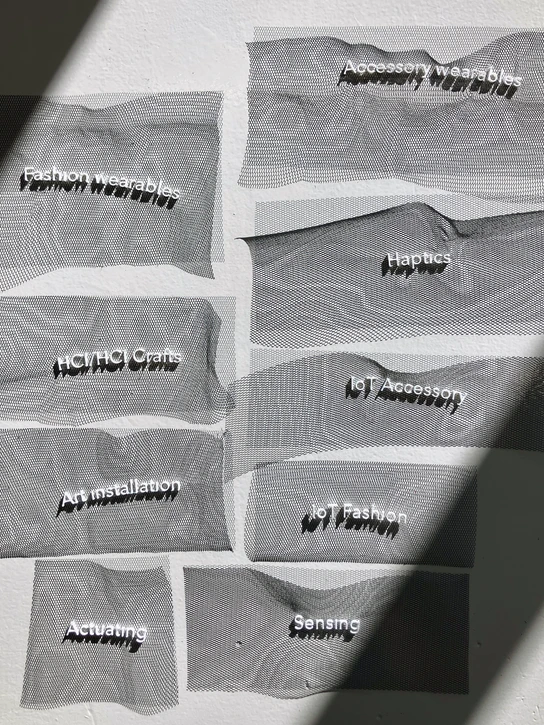
In her artefact-based PhD project, Line Rebecca Rumhult works with artefacts from an embodied perspective, exploring how materials in artefacts can be combined with IoT and connectivity technologies, and how we can create more tactile, bodily objects.
“Line Rebecca Rumhult is working on an artefact-based PhD project at Kolding School of Design”
The artefact functions as the object of study
Artefact-based PhD projects often sit at the intersection of artistic research, practice-based research and academic theory. This places demands on both PhD candidates and supervisors, but also opens up new ways of understanding what research in architecture and design can be.
- It broadens our idea of how knowledge can be produced and shared, and it fits well with a field where thinking and making have always been closely connected, says Claus Peder Pedersen.
Artefact-based PhD projects are one of several possible paths through the PhD programme at Kolding School of Design and Aarhus School of Architecture. They represent a form of research where creative practice and academic reflection meet, and where the particular forms of knowledge found in architecture and design are given space as part of scholarly work.

“When you work artefact-based, you are constantly moving back and forth between writing, methodology and practice. None of these stands alone,” explains PhD student Line Rebecca Rumhult.
“Emma Rishøj Holm uses artefacts in her PhD project at Aarhus School of Architecture.”