
Alberto Bellamoli graduated from Kolding School of Design as an industrial designer and is among the finalists for the Danish Design Award 2026 with OUTT – a new surface material made from waste from the marble industry.
Photo: Stefano Bellamoli
Three Danish Design Award finalists with roots at Kolding School of Design
Behind the projects are industrial designers educated at Kolding School of Design. ASISU, OUTT and ELH tackle very different challenges, but together they demonstrate the breadth of industrial design: from medical devices and new materials to furniture designed to remain relevant as our lives change.
Design that protects during childbirth
ASISU was developed by Julia Sand Skovsted and Ditte Marie Fog Ibsen, who both graduated as industrial designers from Kolding School of Design in 2019.
Between 80 and 90 per cent of women experience perineal tears during vaginal birth. ASISU is a CE-marked medical device developed to reduce the risk by supporting the tissue both externally and inside the vaginal canal as the baby’s head is born.
While midwives primarily protect the tissue manually from the outside, ASISU can provide support further inside, where hands cannot reach. Simulations show that the device can reduce peak strain on the tissue by up to 50 per cent.
This is not Julia Sand Skovsted and Ditte Marie Fog Ibsen’s first encounter with the Danish Design Award. Just one year after graduating, they won two awards in 2020 for their graduation project Poosition – an ergonomic toilet that rethinks the way we sit.

Turning marble waste into a new resource
With OUTT, industrial designer Alberto Bellamoli transforms waste from the marble industry into the main ingredient of a new material.
OUTT is a mineral-based surface material for architecture, made from up to 85 per cent marble dust, chips and fragments left over from marble extraction and processing. Through a patented process, the waste material is combined with a smaller amount of cement-based binder to create durable tiles and surfaces suitable for both indoor and outdoor use.
Instead of ending up as waste, the marble is given a new life as a building material.
Italian designer Alberto Bellamoli graduated from Kolding School of Design in 2016. Already in his graduation project, he explored his home country’s strong terrazzo tradition, rethinking the material through a Danish design approach centred on functionality, aesthetics and the responsible use of resources.
With OUTT, he continues that exploration in the form of a new architectural surface material.

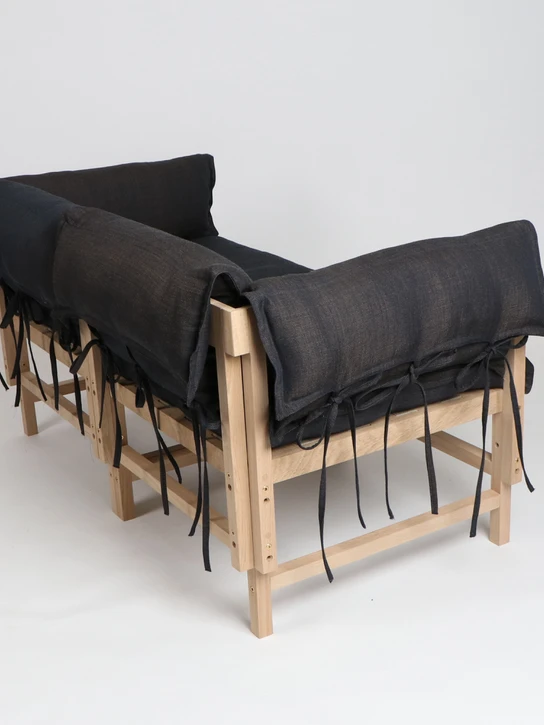
A sofa that does not have to be finished
ELH was developed by Isabella Weber Farrell and Hedvig Aldershaab Boje Djurhuus as their bachelor’s graduation project in Industrial Design at Kolding School of Design in 2025.
The starting point is simple: Why should a sofa be a finished piece of furniture from the moment we buy it, when our homes and our needs continue to change?
ELH begins with a single base that can function as a pouffe and later be expanded into an armchair or a larger sofa. Screw fittings and removable components make the furniture easier to disassemble, repair and build on over time.
Instead of replacing the entire sofa, it can be adapted as needs change.
ELH is a finalist in the Young Ideas category, which highlights promising projects by emerging design talent.
“Congratulations to Julia Sand Skovsted, Ditte Marie Fog Ibsen, Alberto Bellamoli, Isabella Weber Farrell and Hedvig Aldershaab Boje Djurhuus – and to all this year’s Danish Design Award finalists.”
About the Danish Design Award
The Danish Design Award celebrates design that makes a positive difference to people, organisations and society, while showcasing the breadth of Danish design across industries and disciplines.
The award is organised by DDC – Danish Design Center and Design denmark, with Creative Denmark as strategic partner.
This year’s winners will be announced on 5 November 2026 at Nørrebro Teater in Copenhagen.


