The serious art of making space for clowning
If play feels like the wrong response to a situation, it may be exactly what is needed.
When a child or young patient is temporarily living in a hospital room, the space is often already full: the child is exhausted, the parents worn out, and the atmosphere uncertain and tense. Play has to find its way in carefully. But through the professional practice of a hospital clown, the room can begin to feel slightly different.
It is this subtle shift that a research group at Kolding School of Design is working to understand. In a scientific article recently published in the peer-reviewed International Journal of Play, Associate Professor Sofie Kinch and her colleagues examine how researchers around the world have sought to understand the change a hospital clown can create in an encounter with a child.
Research into hospital clowning has grown significantly in recent years, and much of it has documented measurable effects of the encounter between red nose and patient: less anxiety, less crying and greater calm around medical treatment.
This is important knowledge. But behind these effects lies a particular form of professional clowning practice. Understanding it more fully opens up a design perspective that can create new spaces of possibility for more people within the clinical everyday life of the hospital.
“When we began, I thought we would arrive at a design language for improvisation and humour. But as we worked through the material, something else began to emerge: magic, rituals, aura, talismans and small shifts in the perception of reality. It was not what we were looking for, but it was what the material began to point towards,” says Sofie Kinch, lead author of the article.

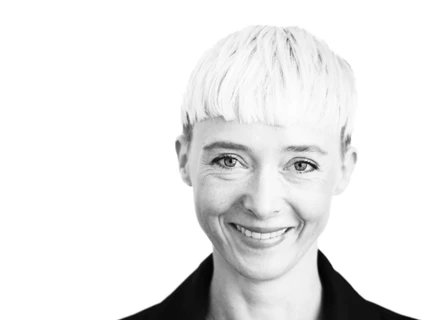
Associate Professor Sofie Kinch from Kolding School of Design has recently published a scientific article exploring the professional practice behind the positive effects hospital clowns can have on patients.
Photo: Rasmus Rørbæk
The magic of the clown
The research team reviewed international literature and, from more than 260 studies, identified 16 in which the distinctive qualities of hospital clowns’ play were described clearly enough to be analysed.
Across countries, disciplines and cultural traditions, the same small traces appeared: clowns transforming the atmosphere of a room, inviting children into play, and leaving behind an object that often carries a renewed meaning once the visit is over.
The design researchers bring these traces together under the concept of transcendent play. A hospital clown can lift a child’s experience of a situation into a space of imagination, joy and participation.
“Across cultures, the work of hospital clowns is described using words such as magic, spirituality and shamanism. These can be difficult concepts to operationalise in a hospital setting. But across the studies, they point to the same quality: the clown’s ability to open up another space within the reality of the hospital – one that can be described as transcendent for those taking part,” Sofie Kinch explains.
Play design meets professional clowning
To understand the work of hospital clowns, the research team uses three established concepts from play design research: Play Order, Play Media and Play Practice. Together, they describe how play becomes possible, what carries it, and how it unfolds in the encounter between child, clown and hospital.
Play Order concerns the framework that signals that something different can happen. A hospital is shaped by treatment, routines, professionals, medical equipment and waiting. When the hospital clown enters, another order can emerge alongside the clinical one. The child is given the opportunity to enter a play order in which they are not only a patient, but also a participant, co-creator and someone able to influence what happens next.
Play Media is what carries the play. It might be a facial expression, music or an object that suddenly takes on a new meaning. In professional clowning practice, objects can become something the child takes with them afterwards – a small talisman from an encounter in which the world briefly felt different.

Associate Professor Sofie Kinch has taken a close look at the work of the Danish hospital clowns in order to design new settings in which their distinctive professional practice can unfold.
Press photo
Play Practice concerns what the clown actually does. The hospital clown reads the room, the child and the family, and adjusts the play accordingly. Sometimes the play can be loud and silly. At other times, it is quiet, gentle and intimate.
“The three concepts from design research make it possible to understand the hospital clown’s work as a professional understanding of the conditions that need to be present for play to emerge in a vulnerable space. This is where the hospital clown becomes interesting from a design perspective.
“When we understand the clown’s actions as rituals, repetition also becomes important. It is not simply about entering the room and getting a laugh. The ritual lies in a kind of familiarity that makes it safer for the child to step into the play,” says Sofie Kinch.
Practice makes perfect
This understanding is already being tested through a collaboration between Danish Hospital Clowns, Aarhus University Hospital and Kolding School of Design.
In a series of workshops, the research team is taking these new insights into the next phase of the work. Young patients, parents, hospital clowns, nurses and others are invited to work with test tubes and different materials, freely naming and mixing them into elixirs representing the intangible qualities that a playful approach to care needs to contain.
So far, the exercise has generated names for materials such as safety, acceptance, future memories, air and chopped chicken.
The point is not the materials themselves, but to give participants a tangible language for moods, transitions and qualities that can otherwise be difficult to articulate.
“It is a medical approach minus all the formulas. There are formulas, but within a different conceptual framework, where safety, acceptance, future memories and air describe an individual’s wish to be able to absorb and hold the situation. The chopped-chicken material reminds us that the clowns’ silliness will always be extremely important,” Sofie Kinch says with a smile.

Test tubes can contain all sorts of things. Here, they bring together the wishes and ideas that emerged during workshops held by the designers with hospital staff, patients and relatives.
When understanding gets wheels
Klovnbulancen is Danish Hospital Clowns’ new mobile wellbeing initiative for children and young people living with long-term or chronic illness.
Behind the many colours and details of Klovnbulancen lies a piece of design work that builds directly on research into playful professional clowning practice.
With Klovnbulancen, hospital clowns have their own mobile space for the first time. For the design researchers, it demonstrates how play design can create settings for professional clowning, vulnerability, imagination and children’s lives.
“For me, this points to a shift in how design research can work with play in vulnerable situations. We can use design to explore what play can open up, and how settings, materials and practices can create the conditions for participation, imagination and presence in situations where people’s room for action is very limited,” says Sofie Kinch.
In this sense, Klovnbulancen also suggests that if design can create the conditions for play in a hospital context, the same thinking may contribute in other vulnerable situations where people need new ways to be present, participate, dream and feel seen.
The article Exploring transcendent play in hospital clowning: An integrative review of hospital clowns’ play qualities and design orientations is written by Sofie Kinch, Zanitha Hamilton Månegaard, Manuela Melo and Helle Marie Skovbjerg from the Lab for Play Design at Kolding School of Design.

As Patron of Danish Hospital Clowns, HM Queen Mary had the opportunity to experience Klovnbulancen first-hand when it was launched in the summer of 2026. Today, it travels around the country, allowing hospital clowns to create their positive impact beyond the walls of the hospital.
Press photo