Design beyond ‘Us and Them’
When was the last time you felt out of place? Perhaps during something as ordinary as taking the train to work? You would think it was a fairly straightforward thing to do.
But.
Imagine boarding the carriage where you have reserved a seat. You turn left, passing the toilet with its faint smell of cleaning products. Just beyond it, you find the space assigned to you. You are sharing it with a pushchair and a sleeping baby. Opposite you, a bicycle is securely fastened in place, while its owner sits further down the carriage, reading at a table.
You cannot get to a table. You cannot move between the seats. The aisle is too narrow for your wheelchair. You have a two-and-a-half-hour journey ahead of you, and you had planned to get some work done along the way.
Still, the baby is rather sweet.
So you take out your phone and photograph your surroundings.
The photograph accompanying this article was taken by Per-Olof Hedvall. The story of that frustrating morning is his own, from a train journey in Sweden. And he has plenty of similar stories and photographs to share.
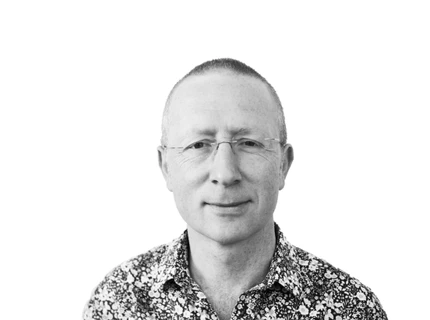
Today, he is Professor of Design at Mid Sweden University and has recently joined Kolding School of Design as Bevica Visiting Professor of Universal Design.
"In my work, I observe and document moments that reveal an 'us' and a 'them' in the way we design our shared world. The train journey is a clear example, and one I experienced first-hand. The space provided for me almost felt like an afterthought on the part of those who designed the carriage. As though someone, at some point, had added a solution for 'them' to make sure there was room for a wheelchair on the train too.
"These are the kinds of everyday markers I collect as data for my research. Every situation tells us something about how we think when we design for one another – and who we overlook in the process," explains Per-Olof Hedvall.

Per-Olof Hedvall documents examples of design that distinguishes between 'us' and 'them' by photographing situations he encounters in everyday life. Here, the space allocated to him on a train was shared with pushchairs and bicycles.
We are all different in different ways
Per-Olof Hedvall's journey into universal design began in IT. For more than a decade, he worked with assistive technology, developing alternative ways of using computers for people whose mobility differed from that of most users. It was a practice built around translating limitations into functionality – an approach that has stayed with him throughout his work in universal design.
"One of the fundamental insights underpinning my work is that we are all different in different ways," he says.
"What I mean is that there is one population, full of differences, rather than a norm based on an imaginary 'normal person' and a number of deviations from that norm. As human beings, we share both similarities and differences, and good design needs to embrace that richness."
Inclusive design is often associated with ramps, specially adapted lifts and wider doorways. Per-Olof Hedvall approaches the question from a different angle.
"I see universal design as a values-driven approach to design. From that perspective, what matters is not only how design benefits individuals, but also how it contributes to the culture around them.
"One of the things I am working on right now is finding clearer ways to identify and track the wider societal impact of universal design. It is about moving from an individual train journey to a broader understanding of our shared world, where we ask ourselves what kind of society we are creating."
A train journey that reveals a bigger question
We return to the train journey because it illustrates one of the questions Per-Olof Hedvall and the design researchers at Kolding School of Design will explore together: How can we become more aware of the definitions and categories that create an 'us' and a 'them' in design? And, perhaps more importantly, how can design move beyond them?
In a recent research article co-authored with colleagues at Lund University, Hedvall argues that accessibility, usability and universal design should be understood as three interconnected layers. Universal design provides the values-based foundation, while accessibility and usability are the tools that put those values into practice.

How can design provide equal opportunities? One example is giving stairs and ramps equal prominence in the design of a space, as seen here at Mid Sweden University, where Per-Olof Hedvall is Professor of Design.
The train journey in Sweden illustrates how these layers work together. Hedvall can board the train and travel from A to B, but that does not mean he can use his journey in the same way as other passengers. He has no access to a table or a power socket, and the space feels more like a luggage area than somewhere to work or quietly enjoy a book.
When explaining his work, Per-Olof often returns to a statement by architect Ronald Mace, who was the first to publicly use the term 'universal design' in 1985. Mace described it as a matter of changing attitudes across society.
"That is a very simplified account, but the central idea is a great source of inspiration in my own work, because that is also how I understand the purpose of universal design.
"It is about drawing attention to the categories we create in the way we organise our surroundings. When you need to use a toilet, the sign on the door might show a man, a woman, a baby-changing station or a wheelchair. On the train, the designated space is marked with a suitcase, a bicycle and a wheelchair. You find the same kind of categorisation in policymaking and many other areas," explains Per-Olof Hedvall.
From his research perspective, this reflects an imbalance. It draws attention to who has been considered in the design of a space, a service or a policy reform – and who has not.
In his own research, Per-Olof Hedvall instead works with a concept known as *nonclusion*. Rather than asking who needs to be included, the concept shifts the focus towards designing on the understanding that everyone already belongs.
"Nonclusion is about creating environments where people with different bodies, experiences and ways of participating can take part without first being treated as exceptions.
"It shifts the role of design from thinking about how to include people to starting from the principle of not excluding them. Asking 'Can everyone use this?' is a different question from asking 'Are we providing access?'" explains Per-Olof Hedvall.

Society uses categories to organise the world around us. This sign in Japan is one example, with each symbol indicating who was considered during the design process. Per-Olof Hedvall believes that the concept of nonclusion can help challenge the need for such categorisation.
A shared question
Per-Olof Hedvall's questions fit naturally with the work of the Lab for Social Design at Kolding School of Design. Here, design researchers explore how design can bring about social and cultural change through close collaboration with the people and organisations affected.
Their research spans active citizenship and communities, universal design and the transitions people experience throughout their lives. Across these areas runs a common question: who does design take for granted as its user, and who is only considered afterwards?
Richard Herriott is an Associate Professor at Kolding School of Design and, together with Canan Akoglu and Kathrina Dankl, has been instrumental in securing the visiting professorship. For them, the collaboration with Per-Olof Hedvall represents an important step towards developing new research projects.
"Very few design researchers have been exploring these questions for as long as Per-Olof, while remaining just as curious and eager to learn more. He has helped shape the very language we use to talk about universal design today, and his almost activist approach to the field is inspiring.
"My hope is that our collaboration through the Bevica Visiting Professorship over the coming year will lay the foundations for many years of research outcomes and new partnerships," says Richard Herriott.
For the Swedish designer, the response to these ambitions is clear:
"It is an honour to have the opportunity to collaborate with Kolding School of Design. But what excites me even more is the thought of all the perspectives and possibilities we will develop together."

Per-Olof Hedvall has joined Kolding School of Design as Bevica Visiting Professor of Universal Design.